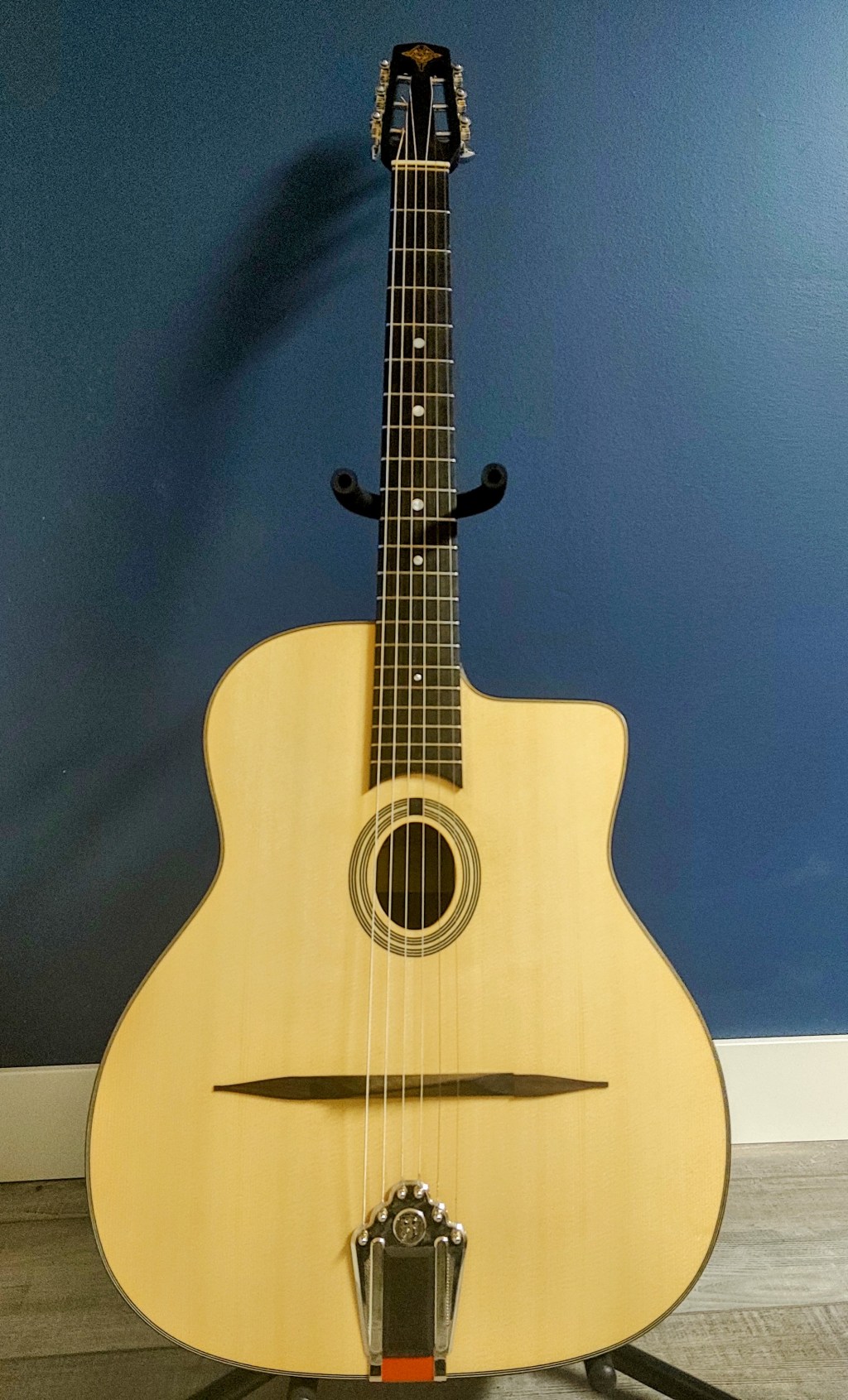
(If it’s not your first day, enjoy this potentially nostalgic trip down memory lane.)
So it’s your first day with the guitar? Fantastic, good choice. You’ve selected an instrument that can do something a little uncommon: it can sound multiple notes at the same time. Easily. Sometimes even if you don’t want it to do that. It’s also portable, flexible, and ubiquitous.
Frustration
There is no getting around it. The first few weeks, and especially the first day, with the instrument will be replete with frustration. There will be flavors of frustration you’re unfamiliar with. I bring this up because I believe that being forthright about it will allow you to appropriately prepare. It’s supposed to be this way.
One of the biggest reasons that it’s frustrating at the start is because nothing else you do day-to-day looks quite like playing the guitar. You are asking for a lot of precise movement out of your hands, they’re engaged with different jobs, and the instrument is giving you feedback that tells you what you’re doing isn’t quite up to snuff just yet. The guitar tries to scamper off your lap, notes don’t ring out clearly, you put your fingers in the wrong place, the strings feel like they’re physically fighting you as you try to suss out how much pressure to use while fretting, they dig into your fingertips, etc.… It’s a mess!
As stated, this is expected. I don’t think anyone picked all this up naturally, and if someone says they did, I strongly suspect they’re a liar. The initial learning curve for the guitar to produce a repeatable sound is awfully steep. Comparatively, you can walk up to a piano and get it to start making sounds intuitively. You just push a key! The guitar tests you. One isn’t inherently easier than the other, so don’t get the wrong idea. The difficulties just appear at different times.
You will rapidly overcome this initial feeling, though. We’re built for learning, more or less, and a little bit of dedicated effort takes the edge off this feeling before you know it. Then you get to move on to other frustrating things, like trying to quickly and cleanly transition between chords or something. The trick is to give yourself permission to screw up, time in which to screw up, and space where you feel comfortable screwing up.
So What Do You Do?
On the first day, or the first few, however long it takes, you focus on the stuff that you can overcome with haste. The things that will make it easier to sit down next time to work on stuff. This might be a little boring to do, but you really only have to pay close attention to it once. Bear with me.
First, check in with how you’re holding the instrument and how you are in space. Are you comfy? Is the position you’re in sustainable? Is the guitar trying to escape to the floor? Are you supporting the weight of the instrument with your hand on the neck (you shouldn’t be)? I’d recommend being seated in a chair that allows you to have your feet flat on the floor without any discomfort, setting the guitar on your leg and letting it support itself against you. You can check if all is well because you should be able to move your hands away from the instrument entirely without it falling away.
Once that is out of the way, we have to check in on the arms, hands, and wrists. I’m going to introduce the idea of a picking hand and a fretting hand, now. The fretting hand is hanging out on the guitar neck; if you’re a right-handed player this is your left hand. The picking hand is hanging out around the body of the guitar, if you’re right-handed, it’s your right hand. Depending on the kind of instrument you have, it might rest comfortably on the body of the guitar. There is some variation; my picking hand doesn’t settle on the instrument the same way for my electric guitar as it does on my nylon string acoustic. Regardless, some things should be true about both of them:
- Your wrists should be in a fairly neutral angle. That is to say, not forming a right angle. They should be relatively straight. If they were suddenly a garden hose, you’d expect water to flow through them without slowing down. If you want to know why this is important, look up “repetitive strain injury.” It’s a bad scene.
- You shouldn’t be expending a great deal of effort to have your hands in this position. Your back, shoulders, forearms, etc… ought to be reasonably relaxed. Obviously you have to put a little effort in to hold the position, but it shouldn’t be tiring. Mentally, the guitar is a bit of a strain. Physically, you should feel pretty good while playing.
I mentioned “repetitive strain injury” above and I wish to bring it up again. If you’re wondering why there would be so much focus dedicated to simply positioning yourself around the instrument correctly, it’s because I am deeply interested in saving you from a world of avoidable pain and also making sure you can come back to the instrument over and over.
Alright, I’m Comfortable, Now What?
Since this is your first day, tune1 the guitar up (EADGbe, from fattest string to thinnest) and then start to figure the instrument out a little. Pluck at, or pick, the strings of your choosing, get them to make some sounds. Fret a note, see how it feels. Don’t press too hard. In fact, experiment to see how gentle you could possibly be while still getting the note to ring out. It is almost guaranteed that you will sound bad. Don’t worry: that is expected and it’s fine. You have my permission, sounding bad is only temporary.
So let’s talk about fretting a little bit. You’ll note that the fret wire itself delineates a little box on the fingerboard. One side of the box is closer to the headstock of the instrument. One side of the box is closer to the body of the instrument. You want your fingertip to come down much, much closer to the body-side on the string. This allows for your best shot at making a good note ring out.
Once you get to the point where you can make a fretted note sound clear, try getting another finger on the frets. See if you can fret two notes at once. The specifics don’t matter; experiment to see if you can make some sounds you like.
My goal here is twofold. There will be plenty of time for dedicated exercises and practice later. Right now, there is probably enough going on with just getting the guitar to make a sound and be comfortable. I don’t want to overload you. Just have some fun with it. But also, if you can make some sounds you like, then we’re in business. Ultimately, all we’re doing when we’re playing any instrument, at any skill level, is making some sounds we like. We’re doing it with more specifics in mind, of course, but that’s the gist of it. If you, on day one, can find some sound that you’re happy with then you are well on your way!
My Fingers Hurt Now
Yeah. Your first few days of practice will be self-limiting because it will hurt, no matter how gentle you’re trying to be on the strings. You will develop some callouses on your fretting hand. If you’re finger picking, you might get them on your picking hand, too. They’ll eventually be unobtrusive and guitar playing will be pain-free. For now, take a break when it hurts. You have to give them some time to develop.
What Next?
You’re in the club, now. I’m going to tell you the names of some notes, locate them on the fingerboard, and tell you what order to put them in. I’m also going to show you musical notation, guitar tablature, and set you up so you can start to read it. We’re also going to discuss some idiosyncrasies of the instrument because those will come to be important later.
Until then, have fun!
A Few Extra Thoughts
This is just a bunch of words on a page. Ideally, they are helpful. Realistically, you’ll still have questions about the instrument. Finding an instructor that can help you nail down some good technique and answer individual questions is a dramatic upgrade to the process.
You might bounce off the guitar a few times. This was true for me. I tried various times throughout my life to pick it up and stick with it and then didn’t touch it again for months or years. Things were different each time I took a crack at it, and eventually everything came together properly and I’ve been at it ever since.
- You have a plethora of options for tuning. Applications on your phone, a clip-on tuner, a friend with perfect pitch and nothing better to do, etc.… All you really want to do is make a series of small adjustments until the guitar is in tune as indicated by the tuning option of your choice. There are some nuances, but they are beyond the scope of your first day.
↩︎
(As an aside, an assurance that I feel is simultaneously necessary and awful at the time of this writing, I did not produce this with the aid (hinderance?) of an LLM. No AI. I’m just a guitar AND writing nerd.)


Leave a comment